Technology
Apple Watch Heart Rate vs Easy Heart Check: Electrical Signal or Sound Signal?
Category: Technology
Apple Watch and Easy Heart Check both help people pay closer attention to their heart. But they do not work in the same way. Apple Watch reads heart data mainly from the wrist, while Easy Heart Check uses a smartphone-based check to analyze multiple cardiac signals, including the sound of the heart.

Apple Watch heart rate monitoring is one of the most familiar ways people track their heart during daily life, exercise and recovery. Easy Heart Check takes a different approach: it helps users run a guided heart check from their smartphone, analyzing heart rate, rhythm, heart sound signals, HRV, recording quality and possible patterns that may deserve further attention.
The main difference is simple: Apple Watch observes the heart from the wrist, while Easy Heart Check analyzes the heart through a smartphone-based signal check that includes sound.
Apple Watch uses sensors integrated into the watch. For everyday heart rate monitoring, it mainly uses an optical sensor that estimates changes in blood flow at the wrist. On compatible models, it can also use electrical sensors to record an ECG similar to a single-lead ECG.
Easy Heart Check, instead, is designed around a guided smartphone check. It does not aim to be a wearable device. It helps users collect and interpret several heart-related signals and turns them into a clear report that can be saved or shared with a healthcare professional.
The key point
Apple Watch mainly monitors the heart from the wrist. Easy Heart Check offers a smartphone-based check that analyzes multiple cardiac signals, including sound-based information. They are not identical tools: they provide two different perspectives on the heart.
The main difference: seeing the heartbeat or listening to the heart
When we talk about the heart, many people immediately think of a number: beats per minute. For example: 65 BPM, 80 BPM or 110 BPM.
But the heart does not communicate through one number only. It produces different types of signals. There is the electrical signal, which coordinates the heartbeat. There is the mechanical activity of the heart and blood flow. And there is the sound signal, produced during the cardiac cycle by valves, movement and blood flow.
Apple Watch is designed to collect heart-related information from the wrist, using optical sensors and, on some models, electrical sensors. Easy Heart Check is built around a different idea: using a smartphone-based guided check to analyze several signals, including the acoustic component of the heartbeat.
This distinction matters because it allows us to explain Easy Heart Check without presenting it as a copy of Apple Watch. It is not the same thing.
Apple Watch reads the heart from the wrist. Easy Heart Check analyzes the heart through a guided smartphone check.
What Apple Watch measures
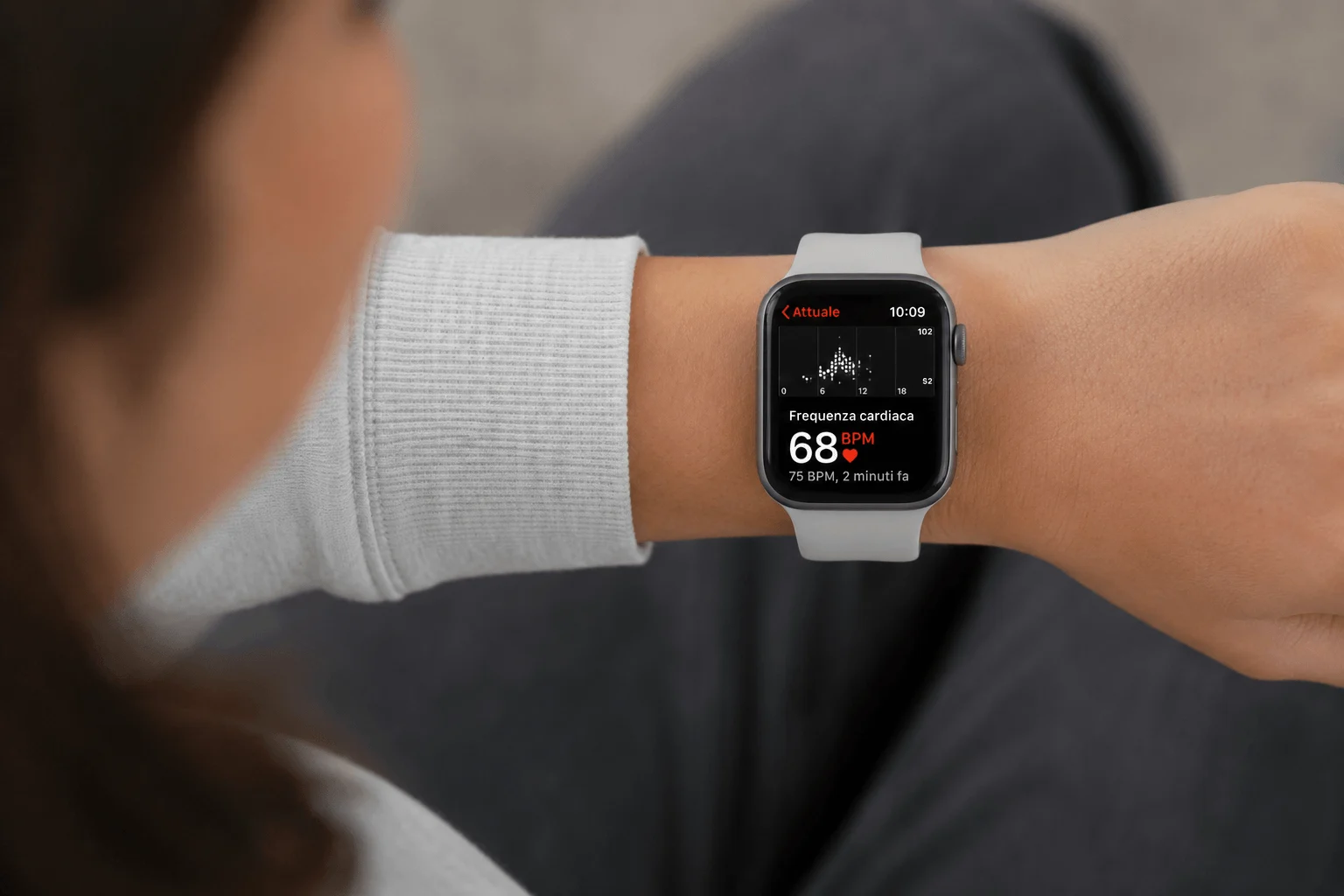
Apple Watch is one of the best-known wearable devices for health and fitness tracking. When it comes to the heart, its main features are related to heart rate, high or low heart rate notifications, irregular rhythm notifications and, on compatible models, the ECG app.
For heart rate monitoring, Apple Watch uses an optical sensor. This technology estimates changes in blood flow at the wrist and calculates beats per minute. This makes it useful for following heart rate during daily life, physical activity and recovery after exercise.
Optical sensor for heart rate
The optical sensor is mainly used to estimate heart rate throughout the day. It is useful because it allows frequent and automatic monitoring directly from the wrist, without requiring the user to start a specific measurement every time.
This makes Apple Watch especially useful for people who want to follow their heart rate trends during workouts, walking, sleep, recovery and everyday activity.
Electrical sensor for ECG
On compatible models, Apple Watch can also record an ECG using electrical sensors. The user places a finger on the Digital Crown, creating a closed circuit that allows the device to record electrical impulses.
The ECG on Apple Watch is similar to a single-lead ECG. This means it observes the heart’s electrical activity from a limited point of view compared with a standard clinical 12-lead ECG.
Important limitation
Apple Watch can provide useful information, but it does not replace a medical evaluation. It cannot detect every heart condition and should not be used to rule out acute or serious problems.
What Easy Heart Check analyzes
Easy Heart Check starts from a different idea: making heart awareness more accessible through a guided smartphone check.
The system is designed to help users collect and interpret several cardiac signals. It does not only display a heart rate number. It can analyze heart rate, BPM, rhythm regularity, HRV, recording quality, main heart sounds such as S1 and S2, possible rhythm patterns, acoustic indicators and signals that may deserve further evaluation.
This is the most important point to communicate:
Easy Heart Check does not simply count beats. It analyzes multiple heart signals.
Many digital tools focus mainly on numbers and activity data. Easy Heart Check adds a different layer: the sound-based component of the heart. The heart does not only beat; it also produces sounds. Those sounds can contain useful information to observe, especially when combined with rhythm, HRV, signal quality and report-based interpretation.
Easy Heart Check is not a diagnosis tool. It is a prevention and awareness support tool. Its goal is to help users listen to their heart with more structure, recognize signals that should not be ignored and understand when it may be appropriate to speak with a healthcare professional.
Electrical signal and sound signal: what really changes?
To understand the difference between Apple Watch and Easy Heart Check, it helps to distinguish two different languages of the heart.
The electrical signal is related to the activity that coordinates each heartbeat. This is what an ECG attempts to record: timing, rhythm and electrical impulses that lead the heart to contract.
The sound signal is related to what can be heard: the classic heartbeat sound, the movement of the valves and the flow of blood during the cardiac cycle.
Apple Watch can read optical and, on compatible models, electrical data from the wrist. Easy Heart Check focuses on a smartphone-based heart check that includes analysis of acoustic signals and other heart-related parameters.
| Feature | Apple Watch | Easy Heart Check |
|---|---|---|
| Type of tool | Wearable device worn on the wrist | Web app / digital platform used from a smartphone |
| Acquisition point | Wrist | Guided smartphone-based heart check |
| Main technology | Optical sensor for heart rate; electrical sensors for ECG on compatible models | Smartphone-based signal analysis including heart sound information |
| Main signal type | Optical and, for ECG, electrical | Multi-signal analysis, including acoustic heart signals |
| What it observes | Heart rate, heart rate trends, notifications and ECG on compatible models | Heart rate, rhythm, HRV, recording quality, heart sounds, possible rhythm patterns and report indicators |
| Hardware required | Compatible Apple Watch | Compatible smartphone |
| Main use | Continuous or frequent wrist-based monitoring | Guided heart check with structured report |
| Medical diagnosis? | No, within the limits stated by the manufacturer | No, prevention and awareness support only |
This table explains the positioning clearly: Easy Heart Check should not be presented as a copy of Apple Watch. It is a different type of tool with a different logic.
Why heart sounds can provide useful information
The heart has always been listened to. Doctors use a stethoscope because heart sounds can provide useful information about rhythm, valves and possible abnormal sounds.
The main heart sounds are often referred to as S1 and S2. They are connected to the cardiac cycle and to the movement of the valves. In simple terms, they are part of the classic heartbeat sound.
This does not mean that a smartphone-based recording replaces medical auscultation. It means that sound is a real channel through which the heart communicates.
The value of Easy Heart Check
Easy Heart Check uses this principle in a digital form: it helps collect, analyze and organize heart-related signals into a report. It is not a diagnosis, but it can help users observe their heart with more awareness.

Easy Heart Check goes beyond heart rate
One of the most common misunderstandings is thinking that Easy Heart Check is only a heart rate tool. It is not.
Heart rate is only one part of the check. Easy Heart Check can also analyze rhythm regularity, HRV, the quality of the recording, main heart sounds, possible extrasystoles or rhythm patterns, possible murmur indicators and signs compatible with rhythm irregularity that may deserve further medical evaluation.
| Area of analysis | What it looks at | Why it matters |
|---|---|---|
| Heart rate | Estimated beats per minute during the check | Gives a basic view of how fast the heart is beating in that moment |
| Rhythm regularity | Intervals between beats and overall rhythm pattern | Can highlight patterns that may deserve attention |
| HRV | Natural variability between heartbeats | Adds information about the dynamics of the heartbeat |
| Heart sounds | Main acoustic signals such as S1 and S2 | Helps interpret the sound structure of the heartbeat |
| Possible acoustic indicators | Sound patterns that may need further evaluation | Can support a better conversation with a healthcare professional |
| Recording quality | Signal clarity and suitability for analysis | Helps determine whether the check should be repeated |
| Report | Visual summary of the check | Can be saved, compared over time or shared with a doctor |
This broader view makes Easy Heart Check more than a simple BPM measurement. It is a guided heart check designed to support awareness and prevention.
When to use Apple Watch and when to use Easy Heart Check
Apple Watch can be useful when you want to follow heart rate during the day, during physical activity or while recovering after exercise. It is a wearable device, always on the wrist, designed to collect data at different moments of daily life.
Easy Heart Check is different. It is designed for a specific moment of heart awareness: you stop, follow the guided check and receive a structured report.
In practice:
- Apple Watch is useful for wrist-based monitoring throughout the day.
- Easy Heart Check is useful when you want a guided smartphone-based heart check with a broader signal analysis.
You do not necessarily need to choose one against the other. They have different roles.
A person may use Apple Watch to follow workouts, heart rate trends and notifications, and use Easy Heart Check when they want a more structured check focused on multiple cardiac signals.
Two complementary tools, not competitors
The best way to explain the difference is to avoid aggressive claims such as “Easy Heart Check is better than Apple Watch” or “Apple Watch is useless.” That would be inaccurate and not helpful for users.
It is much more credible to say that Apple Watch and Easy Heart Check offer two different perspectives on the heart.
Apple Watch follows the heart from the wrist, using optical and electrical sensors. Easy Heart Check provides a guided smartphone-based check that analyzes multiple signals, including sound-related information.
Apple Watch
Follows heart activity during daily life, especially from the wrist, with frequent monitoring and integrated wearable features.
Easy Heart Check
Provides a guided heart check from the smartphone, analyzing multiple signals and producing a clear, shareable report.
Important limitations to know
When talking about the heart, technology should never create false confidence.
Apple Watch can provide useful data, but it cannot detect every heart problem and does not replace a medical examination. Easy Heart Check must also be used correctly: as a prevention and awareness support tool, not as a substitute for medical care.
The rule is simple: if you have chest pain, shortness of breath, fainting, severe weakness or sudden symptoms, do not wait for an app or device. Contact a doctor or emergency services immediately.
In case of acute symptoms
Do not use Apple Watch, Easy Heart Check or any other digital tool to delay emergency care. Chest pain, severe shortness of breath, fainting or sudden weakness require immediate medical attention.
Want to check your heart from your smartphone?
With Easy Heart Check, you can run a guided heart check from your smartphone and receive a clear report based on multiple cardiac signals. No wearable device required.
Frequently asked questions
Do Apple Watch and Easy Heart Check do the same thing?
No. Apple Watch reads heart data from the wrist using optical sensors and, on compatible models, electrical sensors for ECG. Easy Heart Check provides a guided smartphone-based heart check that analyzes multiple cardiac signals, including sound-related information.
Does Apple Watch use an electrical signal?
Yes, but only for specific features and on compatible models. For ECG, Apple Watch uses electrical sensors. For everyday heart rate monitoring, it mainly uses an optical sensor that estimates blood flow changes at the wrist.
Does Easy Heart Check use an electrical signal?
No. Easy Heart Check is not an ECG and does not read the electrical activity of the heart. It provides a smartphone-based check that analyzes multiple heart-related signals, including acoustic heart information.
Is the sound of the heart useful?
Yes. Heart sounds have always been part of cardiac observation. Doctors use a stethoscope to listen to the heart. Easy Heart Check brings this principle into a digital and guided format, without replacing the doctor.
Does Easy Heart Check only measure heart rate?
No. Easy Heart Check can analyze heart rate, BPM, rhythm regularity, HRV, recording quality, main heart sounds, possible rhythm patterns, possible murmur indicators and signs compatible with rhythm irregularity that may deserve further evaluation.
Does Easy Heart Check replace Apple Watch?
No. They are different tools. Apple Watch is a wearable device. Easy Heart Check is a guided smartphone-based heart check. They can be considered complementary, not alternative, tools.
Does Easy Heart Check provide a diagnosis?
No. Easy Heart Check is a prevention and awareness support tool. It does not replace a medical visit, an ECG or a specialist evaluation.
Can Apple Watch detect a heart attack?
No. Apple Watch should not be used to detect or rule out a heart attack. In case of chest pain, shortness of breath, fainting or sudden symptoms, emergency services should be contacted immediately.
Which is better: Apple Watch or Easy Heart Check?
It is not a matter of one being better in every situation. Apple Watch is useful for continuous wrist-based monitoring. Easy Heart Check is useful when you want a guided smartphone-based check that analyzes multiple cardiac signals. They serve different purposes and can work together.
Do I need an additional device to use Easy Heart Check?
No. Easy Heart Check is designed to be used from a smartphone. You do not need to wear a smartwatch or buy a dedicated external device to run the guided check.
Can I share the Easy Heart Check report with a doctor?
Yes. The report can be saved, reviewed over time and shared with a healthcare professional when needed. It can help you describe what you observed more clearly, but it does not replace medical evaluation.
Conclusion
Apple Watch and Easy Heart Check both talk about the heart, but they do it in different ways.
Apple Watch measures heart rate from the wrist using optical sensors and, on compatible models, electrical sensors for ECG. Easy Heart Check provides a guided smartphone-based heart check that analyzes multiple signals, including heart rate, rhythm, HRV, recording quality and acoustic heart information.
The difference is simple:
Apple Watch reads the heart from the wrist. Easy Heart Check analyzes multiple heart signals from a guided smartphone check.
This is where Easy Heart Check finds its place: not as a copy of a wearable, but as a simple, accessible and non-invasive digital tool that helps people listen to their heart with more awareness.
Prevention does not start with fear. It starts with attention. Learning to observe the heart more clearly can be a concrete first step.
Start your first Easy Heart Check
Run a guided smartphone-based heart check and get a clear report based on multiple cardiac signals. Simple, fast and non-invasive.
this content is for informational purposes only and does not replace medical advice.
Easy Heart Check is a prevention and awareness support tool and does not provide diagnosis.
In case of chest pain, shortness of breath, fainting, severe weakness or sudden symptoms,
contact a doctor or emergency services immediately.