How Easy Heart Check Works: A Simple, Complete Heart Check from Your Smartphone
Category: Practical guide
Easy Heart Check is a digital platform that lets you perform a simple, quick, and non-invasive heart check from your smartphone. It does more than count heartbeats: it listens to, measures, and interprets several cardiac signals, turning them into a clear report that you can save or share with your doctor.

When people hear about checking the heart with a smartphone, many immediately think of a simple heartbeat counter. Easy Heart Check was created with a broader goal: to offer a simple but complete overview of certain cardiac signals that can be detected through a guided recording.
The platform analyzes heartbeat, rhythm, and certain heart sounds, organizing the information in a visual, easy-to-read report. You can save this report, compare it over time, or share it with a healthcare professional.
The most important point is this: Easy Heart Check supports prevention and awareness. It does not replace a doctor, an ECG, or a medical diagnosis.
The key point
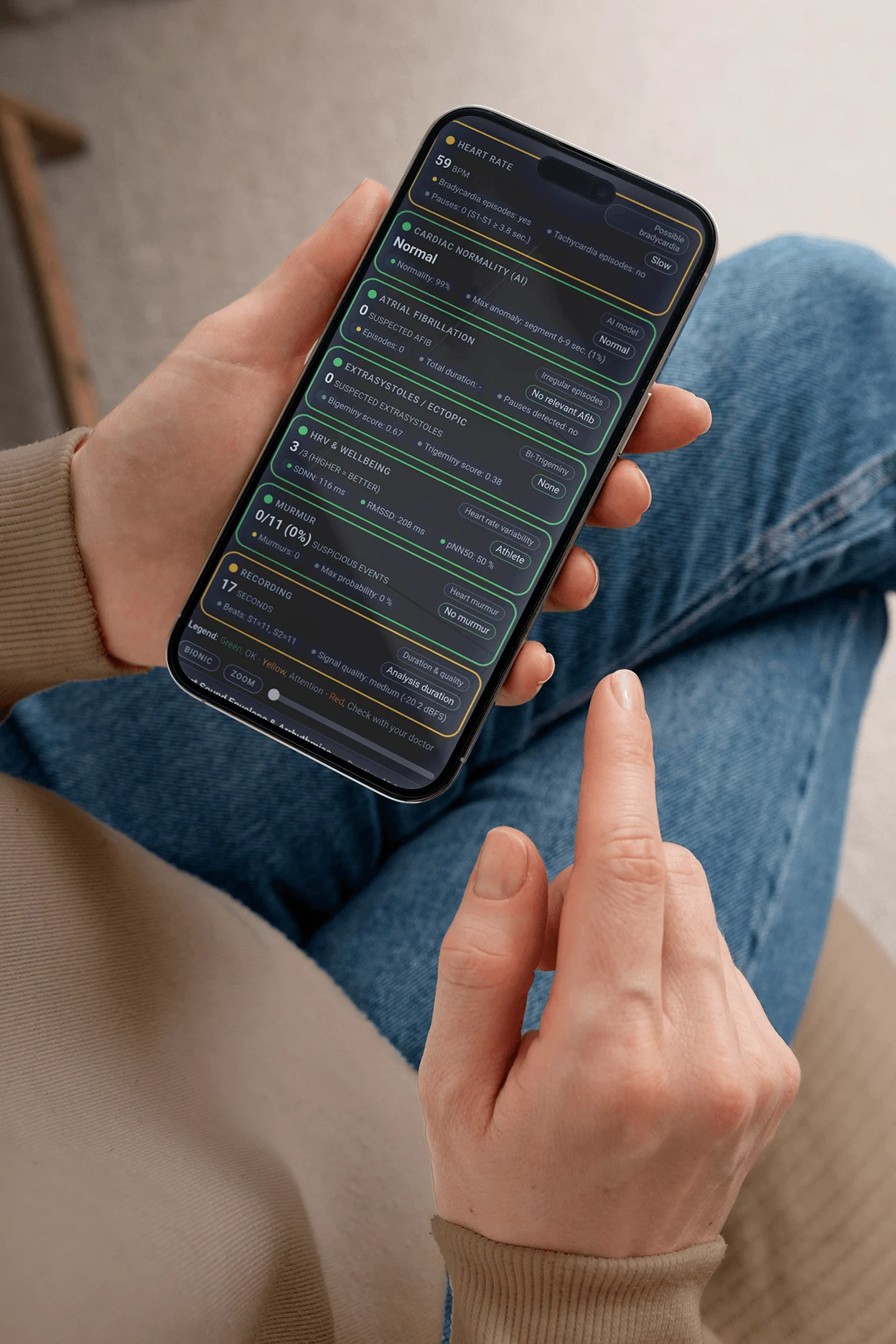
Easy Heart Check does more than count heartbeats. It collects and interprets several cardiac signals: rate, rhythm, HRV, recording quality, the main heart sounds, possible rhythm patterns, and acoustic signals that may deserve further evaluation.
What is Easy Heart Check?
Easy Heart Check is a web app designed to make an initial heart check more accessible. The user can make a guided recording with a smartphone, without wearable devices or complicated procedures.
The system is based on a simple principle: the heart produces signals that can be observed from different perspectives. Some tools read the electrical signal, others estimate heart rate at the wrist, while Easy Heart Check also focuses on the sound component and digital signal analysis.
The platform therefore helps you observe the heart through four main actions:
Listen
It analyzes the main heart sounds, such as S1 and S2, and possible abnormal acoustic signals.
Measure
It evaluates heart rate, BPM, HRV, heartbeat patterns, and possible rhythm irregularities.
Interpret
It uses AI to read the signal, assess recording quality, and generate a clear report.
Share
It lets you save results, compare them over time, or show them to a healthcare professional.
Easy Heart Check is not just a heartbeat monitor: it is a simple but complete first digital heart check.
How Easy Heart Check works in practice
The experience is designed to guide you step by step. You access the platform, follow the instructions, position the smartphone correctly, and start the recording.
During the check, the system collects the signal, evaluates whether the recording is clear enough, and organizes the detected data into a final report.
In practice, the process can be summarized as follows:
- Access the platform: open Easy Heart Check on your smartphone.
- Follow the instructions: the web app guides you through preparation.
- Record the signal: the smartphone collects the data needed for analysis.
- Check the quality: the system verifies whether the recording is clear enough.
- Read the report: the results are organized visually and clearly.
- Share it when useful: you can use the report to discuss the results with your doctor.

What does Easy Heart Check analyze?
Easy Heart Check analyzes several cardiac signals. This is the most important point to communicate: it does not return only a heartbeats-per-minute value, but a broader overview of the recorded signal.
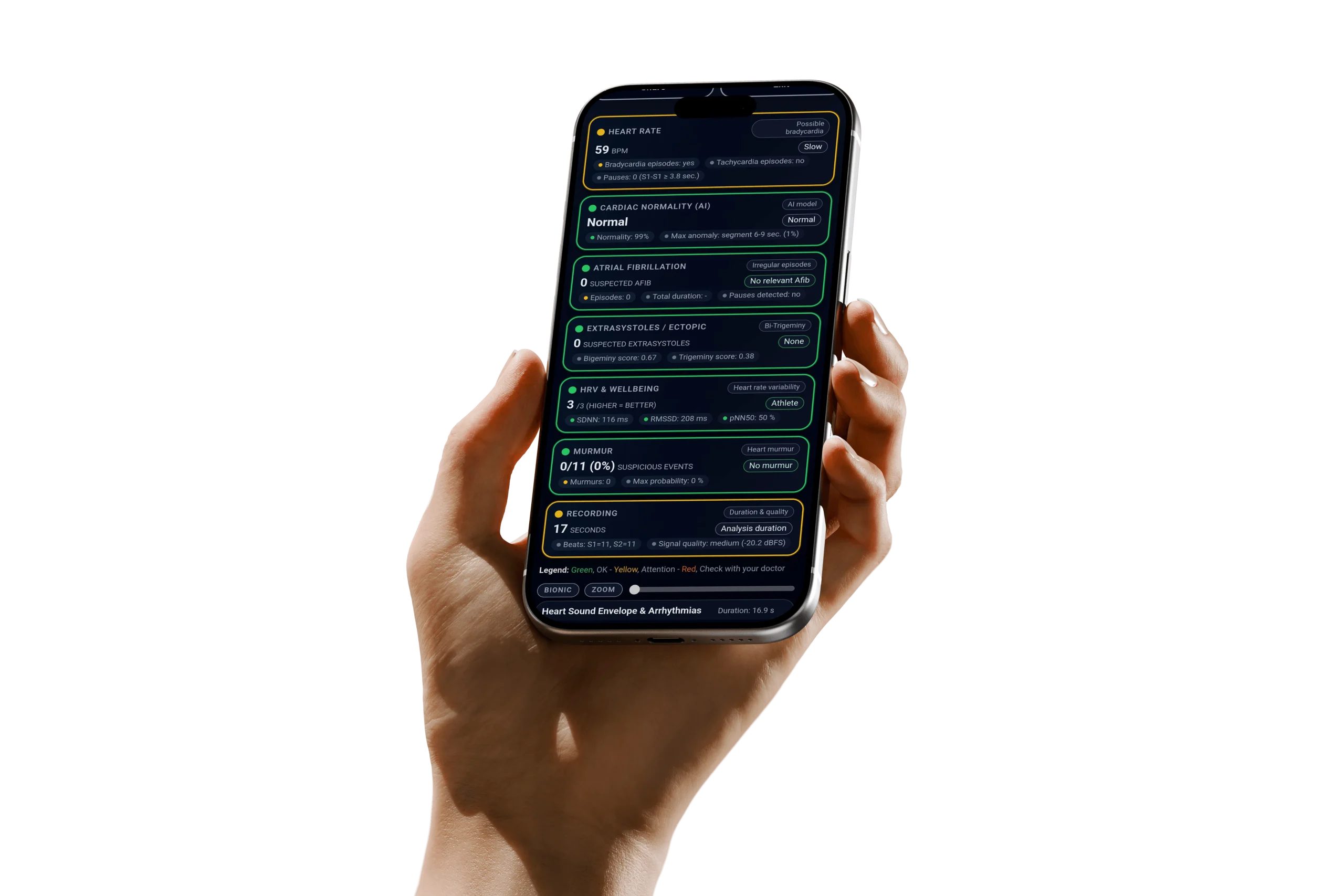
The main areas of analysis include heart rate, rhythm, HRV, acoustic characteristics, possible rhythm patterns, and signals that may deserve further evaluation.
| Area of analysis | What it observes | Why it may be useful |
|---|---|---|
| Heart rate | Estimated BPM, rate classification, and detected pauses | Helps you understand the heart-rate level during the recording |
| Rhythm regularity | Intervals between beats, variability, and overall regularity | Helps show whether the rhythm appears stable or irregular |
| AI acoustic normality | Overall characteristics of the recorded heart sound | Helps distinguish signals compatible with a normal pattern from signals that may require further evaluation |
| Premature beats and rhythm patterns | Possible premature beats, bigeminy, or trigeminy | May highlight patterns that deserve medical attention |
| Possible heart murmur | Additional acoustic energy between the normal heart sounds | May identify an acoustic signal to discuss with a doctor |
| HRV | RMSSD, SDNN, pNN50, and overall variability | Provides information about natural variations between heartbeats |
| Atrial fibrillation screening | Analyzed windows, possible irregularity, and suspected AF | May highlight features compatible with an irregular rhythm that should be evaluated further |
| Recording quality | Signal clarity and suitability for analysis | Helps you understand whether the check is readable or should be repeated |
All of these data should be viewed as support for awareness, not as a diagnosis. When a result identifies something that deserves further evaluation, the correct next step is to discuss it with a healthcare professional.
Heart rate and BPM
Heart rate is the estimated number of heartbeats per minute during the recording. It is one of the most intuitive measurements because many people are familiar with BPM values.
Easy Heart Check may show estimated BPM, a heart-rate classification, and the number of detected pauses. This value, however, should not be interpreted on its own.
Your heartbeat can change for many reasons: physical activity, stress, sleep, caffeine, temperature, medication, emotions, or individual conditions. It is therefore important to consider the context in which the recording was made.
Do not look only at the number
A heart-rate value makes sense only when viewed in context: were you resting, anxious, recovering from exertion, after drinking coffee, or experiencing a symptom?
Heart rhythm regularity
Heart rhythm is not only about how fast the heart beats, but also about how the beats are distributed over time.
Easy Heart Check evaluates the intervals from one heartbeat to the next, beat-to-beat variability, and overall rhythm regularity. This may help identify irregularities or patterns that deserve attention.
A rhythm that feels irregular does not automatically mean that a medical condition is present, but it should not be ignored when it is recurrent, prolonged, or associated with symptoms such as chest pain, breathlessness, dizziness, or fainting.
HRV: heart rate variability
HRV, or heart rate variability, measures natural changes in the intervals between heartbeats. The heart does not beat like a perfect metronome: even under normal conditions, there are small differences from one beat to the next.
Easy Heart Check can analyze overall HRV, reduced or increased variability, and indicators such as RMSSD, SDNN, and pNN50.
HRV is an interesting measurement, but it must be interpreted carefully. It can change with sleep, stress, physical activity, fatigue, breathing, and many other factors. It should not be used alone to draw conclusions about your health.
Main heart sounds: S1 and S2
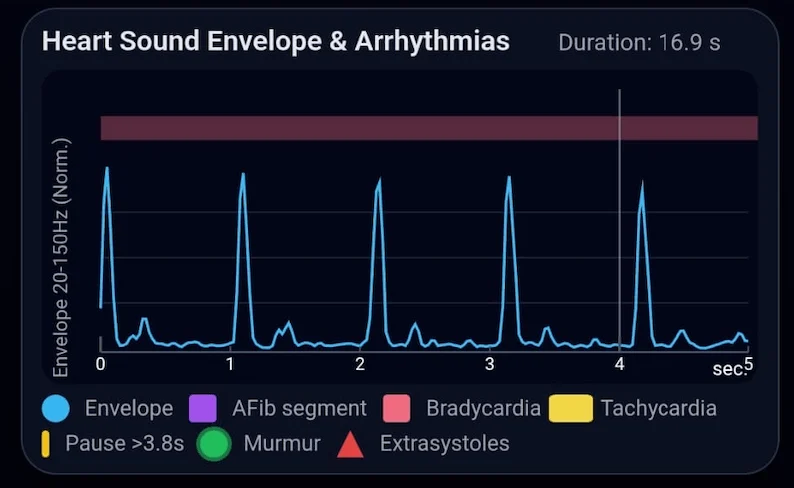
One distinctive feature of Easy Heart Check is its analysis of the main heart sounds, including S1 and S2. These sounds are part of the normal cardiac cycle and are related to valve movement and blood flow.
The system listens to the heart’s acoustic signal and may highlight features compatible with sound changes that deserve further evaluation.
This does not mean replacing a doctor’s stethoscope or a clinical evaluation. It means using technology to turn a sound recording into more readable and organized data.
AI acoustic normality
Easy Heart Check includes an automated assessment of the overall characteristics of the recorded heart sound.
This analysis may return an acoustic-normality indicator, a confidence level, and a classification of the analyzed signal. In simple terms, artificial intelligence helps read the signal and distinguish features compatible with a normal pattern from features that may deserve attention.
It is essential to avoid confusion here as well: AI does not make a clinical diagnosis. It provides a supportive interpretation that may help indicate whether further evaluation could be useful.
AI does not mean an automatic diagnosis
Artificial intelligence can help read the signal, but the result remains informational support. A diagnosis must always be made by a doctor.
Possible premature beats and rhythm patterns
Easy Heart Check can analyze unusual alternations in the duration and shape of heartbeats. Observable features may include possible premature beats, possible bigeminy, and possible trigeminy.
These terms describe rhythm patterns that may occur in certain situations and that deserve medical evaluation when recurrent or associated with symptoms.
It is important to use careful language: Easy Heart Check may highlight signals compatible with these patterns, but it should not be presented as a tool that diagnoses arrhythmias.
Possible heart-murmur indicator
Another important area is the analysis of additional acoustic energy between the normal heart sounds.
Easy Heart Check may indicate a detected level, a possible murmur finding, and a signal that deserves further evaluation. This is important from a communication standpoint because it shows that the product is not limited to heart rate.
Here too, the wording must remain accurate: this is a possible heart-murmur indicator, not a diagnosis of a heart murmur.
Correct wording to use
“Easy Heart Check may highlight acoustic signals compatible with a possible heart murmur that should be evaluated further,” not “Easy Heart Check diagnoses a heart murmur.”
Atrial fibrillation screening
Easy Heart Check can analyze rhythm variability and organization to identify features compatible with an irregular rhythm.
The report may include the number of analyzed windows, windows with possible irregularity, and suspected atrial fibrillation.
This information must be communicated very carefully. Screening is not a diagnosis. A suspicion or compatible signal always requires medical evaluation, especially when the person experiences palpitations, breathlessness, weakness, dizziness, or other symptoms.
Screening means “further evaluation may be needed”
If Easy Heart Check shows a feature compatible with a possible irregular rhythm or suspected atrial fibrillation, the correct step is to discuss it with a doctor. Do not attempt to diagnose yourself.
Recording quality
Recording quality is essential. A noisy recording can make signal analysis more difficult.
Easy Heart Check checks whether the recording is clear enough to be analyzed correctly. When the signal is noisy, weak, or difficult to read, repeating the check may be appropriate.
To improve recording quality:
- choose a quiet environment;
- avoid music, television, or background conversations;
- remain still during the check;
- do not speak during the recording;
- follow the position shown by the platform;
- repeat the check if signal quality is insufficient.
| Problem | Possible effect | What to do |
|---|---|---|
| Environmental noise | May overlap with the heart sound | Choose a quiet room |
| Phone movement | May introduce interference into the signal | Remain still and follow the instructions |
| Voice or conversations | May interfere with the recording | Stay silent during the check |
| Weak signal | May reduce the readability of the analysis | Repeat the check while following the procedure more carefully |
Charts and reports: clear, shareable results
Each check generates intuitive charts and a final report containing the main detected information.
The report may be useful for:
- saving a recording over time;
- comparing several checks;
- observing whether certain signals recur;
- showing clearer information to your doctor;
- avoiding reliance on memory alone when describing an episode.
This is one of the most important practical benefits: when people experience palpitations or unusual sensations, it can be difficult to explain exactly what happened. A report can help you bring more organized information to a medical visit.
Prevention, not diagnosis
Easy Heart Check should be used correctly: as support for heart-health awareness and prevention, not as a diagnostic tool.
The platform can help you listen to your heart more easily, recognize signals that should not be ignored, and bring clearer information to your doctor when needed.
It should not be used to:
- rule out a heart problem;
- replace an ECG;
- replace a cardiology visit;
- decide on your own whether to start, stop, or change a treatment;
- manage an emergency;
- delay seeking help when important symptoms are present.
In case of acute symptoms
Chest pain or pressure, difficulty breathing, fainting, severe weakness, confusion, or sudden symptoms require immediate assistance. In these situations, do not use a web app to decide whether to seek help: call 112 or your local emergency services immediately.
Who is Easy Heart Check designed for?
Easy Heart Check is designed for people who want to pay closer attention to their heart in a simple, guided, and accessible way.
It may be useful for:
- people who want to perform an initial digital heart check with a smartphone;
- people who want to observe heartbeat, rhythm, and heart sounds in a more organized way;
- people who want to save reports over time;
- people who experience palpitations and want to collect information to share with a doctor;
- people who want a simple, non-invasive prevention tool;
- people who want to understand certain signals from their heart more clearly.
Anyone with an existing heart diagnosis, important symptoms, or specific instructions from a cardiologist should continue to follow the prescribed medical plan.
Easy Heart Check does not replace your doctor. It helps you arrive with clearer information when medical advice is needed.
Try Easy Heart Check
Perform a simple, non-invasive heart check with your smartphone. Listen to, measure, and interpret several cardiac signals through a guided recording.
Mistakes to avoid when using Easy Heart Check
To use Easy Heart Check correctly, it is important to avoid several common mistakes.
| Mistake | Why it is a problem | What to do instead |
|---|---|---|
| Thinking it measures only heartbeats | This understates the tool’s real value | Also consider rhythm, HRV, heart sounds, AI, and the report |
| Recording in a noisy environment | It may compromise the signal | Choose a quiet place |
| Interpreting the report as a diagnosis | It may create false reassurance or unnecessary alarm | Use it as informational support |
| Repeating the check compulsively | It may increase anxiety | Make checks at defined times and note the context |
| Using it during an emergency | It may delay assistance | Call 112 immediately when acute symptoms are present |
Frequently asked questions
Does Easy Heart Check measure only your heartbeat?
No. Easy Heart Check analyzes several cardiac signals: heart rate, BPM, HRV, heartbeat patterns, rhythm regularity, recording quality, the main heart sounds, possible rhythm patterns, a possible heart-murmur indicator, and atrial fibrillation screening.
Does Easy Heart Check analyze heart sounds?
Yes. The platform analyzes the main heart sounds, such as S1 and S2, and may highlight acoustic signals compatible with possible abnormalities or heart murmurs that should be evaluated further.
Can Easy Heart Check indicate a possible heart murmur?
It can analyze additional acoustic energy between the normal heart sounds and indicate a possible signal that deserves further evaluation. It does not, however, diagnose a heart murmur.
Does Easy Heart Check screen for atrial fibrillation?
It can analyze rhythm variability and organization to identify features compatible with an irregular rhythm and possible suspected atrial fibrillation. The result should always be discussed with a doctor.
Can Easy Heart Check detect premature beats?
It can analyze unusual alternations in heartbeat duration and shape and flag possible premature beats or patterns such as bigeminy and trigeminy. It does not replace a cardiology diagnosis.
What is AI acoustic normality?
It is an automated assessment of the overall characteristics of the recorded heart sound. AI helps classify the signal and indicate whether it contains features compatible with a normal pattern or features that may deserve further evaluation.
Does Easy Heart Check measure HRV?
Yes. Easy Heart Check can analyze heart rate variability, including indicators such as RMSSD, SDNN, and pNN50.
Is the Easy Heart Check report a diagnosis?
No. The report is informational support and does not replace medical advice, an ECG, or a cardiology visit.
Can I share the report with my doctor?
Yes. The report can be saved, compared over time, or shared with a healthcare professional when useful.
Can Easy Heart Check be used during an emergency?
No. Easy Heart Check is not an emergency tool. In case of chest pain, difficulty breathing, fainting, or sudden symptoms, call 112 or your local emergency services immediately.
Conclusion
Easy Heart Check is not a simple heartbeat monitor. It is a smartphone heart check that listens to, measures, and interprets several cardiac signals: rate, rhythm, HRV, heart sounds, recording quality, possible rhythm patterns, acoustic indicators, and irregular-rhythm screening.
Its value lies in making an initial moment of listening to and observing the heart more accessible, turning a guided recording into a clear, shareable report.
The correct way to use it is as support for prevention, not as a diagnosis. It can help you recognize signals that should not be ignored and bring more organized information to your doctor when needed.
Easy Heart Check does not promise to replace your doctor. It helps you listen to your heart more closely and understand when further evaluation may be useful.
Start your first check with Easy Heart Check
Use your smartphone to perform a simple, guided, and non-invasive heart check. Listen to, measure, and interpret several signals from the heart.
This content is provided for informational purposes only and does not replace medical advice. Easy Heart Check supports awareness and prevention, does not provide diagnoses, and does not replace an ECG, a cardiology visit, or specialist evaluation. In case of chest pain, difficulty breathing, fainting, severe weakness, confusion, or sudden symptoms, call 112 or your local emergency services immediately.